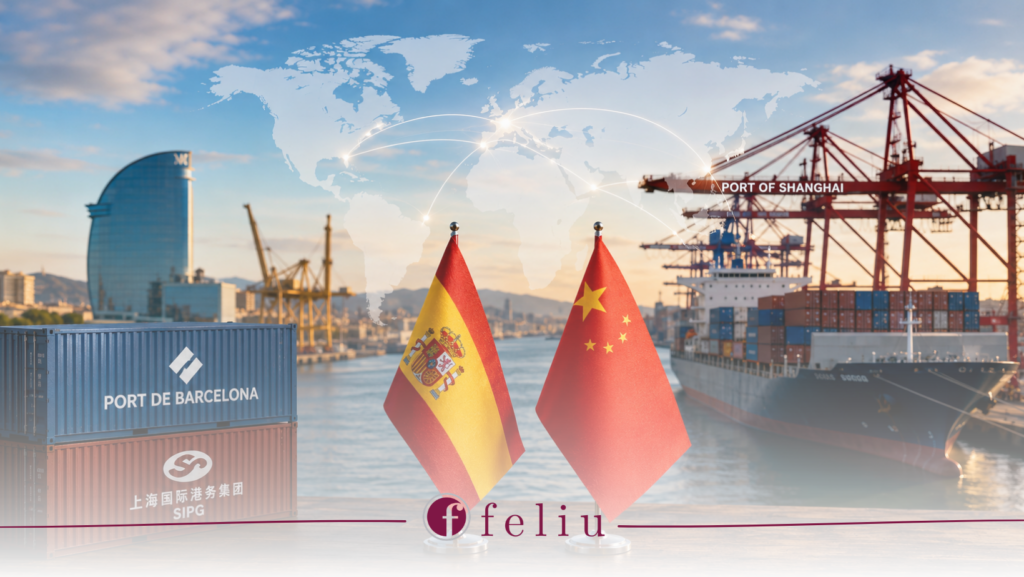
On 10 June 2026, the Port of Barcelona, the Shanghai Municipal Transportation Commission (SMTC) and the Shanghai International Port Group (SIPG) signed a new strategic cooperation agreement officially establishing the “sister ports” relationship between both infrastructures. The agreement consolidates years of joint work and creates a formal framework for technical collaboration between two of the most relevant logistics nodes on the Europe-Asia axis.
For companies on both sides that operate or want to operate along this corridor, the agreement sends an unambiguous signal: the Barcelona-Shanghai axis is ceasing to be just another route and becoming a dedicated corridor with formalised technical collaboration and growing logistics connectivity between the Mediterranean and the Far East.
A corridor that has been taking shape for years
The relationship between both ports has been built progressively on solid technical foundations. In July 2025, both port authorities signed a preliminary cooperation agreement, followed in September 2025 by a technical visit to Barcelona by a Shanghai delegation focused on advancing the Green Shipping and Digital Corridor being developed between the two ports.
The strategic agreement of June 2026 establishes a collaboration framework in areas that directly affect companies operating along this axis: port digitalisation and security, green port development, alternative fuels, intermodality, and the promotion of sustainable maritime corridors between the Far East and the Mediterranean.
During the Chinese delegation’s visit, tours were also conducted of industrial facilities in Barcelona’s Zona Franca and the vehicle terminal operated by Autoterminal, reflecting Chinese interest in industrial sectors with a strong presence in the Barcelona metropolitan area. This type of technical exchange is typically the precursor to investment decisions and the expansion of commercial relations between companies from both countries.
For Spanish companies: more structured access to the Chinese market
With this agreement, the Port of Barcelona strengthens its position as a Euro-Mediterranean logistics hub while deepening ties with one of the world’s leading ports. For Spanish companies that export to China, import from there, or have or plan to have an operational structure in the country, this translates into greater predictability in transit times, better intermodality conditions and a corridor with formalised technical support.
However, improved logistics does not simplify the operational complexity of being present in China. The legal structure of the establishment, the tax framework, the management of local and expatriate staff, customs compliance and contract management with Chinese counterparts are all elements that require expert planning. Companies that enter the Chinese market with a well-designed structure from the outset will have a significantly stronger competitive position than those that improvise their entry.
For Chinese companies: Barcelona as a gateway to Europe
The growing interest of Chinese companies in establishing themselves in Barcelona and Spain is no coincidence. Barcelona is the leading logistics hub in southern Europe, with direct connections to the main European markets, access to the EU single market and a port infrastructure that, with this agreement, further strengthens its connectivity with China.
For a Chinese company looking to establish its European base in Barcelona, the advantages are multiple: direct access to the EU market, a first-class logistics base, a consolidated international business ecosystem and a quality of life that facilitates the attraction and retention of senior talent. And now, additionally, a maritime corridor with Shanghai that is being technically formalised and that reduces operational friction between the Chinese headquarters and the European subsidiary.
Establishing in Spain as a foreign company does, however, require navigating a specific legal, tax and labour framework. The choice of the appropriate corporate structure, the optimal tax setup, the management of visas and work permits for Chinese management staff relocating to Spain, and compliance with labour and Social Security obligations are all aspects that must be resolved from the first day of operations.
Does your company want to operate along this corridor, from Spain to China or from China to Spain?
At Feliu N&I, we have more than 20 years of experience supporting both Spanish companies in their internationalisation in Asia and foreign companies, including Chinese companies, in their establishment in Spain. We know both sides of the corridor and can help you structure your operations correctly, efficiently and with full legal certainty from the very first step.
Contact us for a personalised consultation.