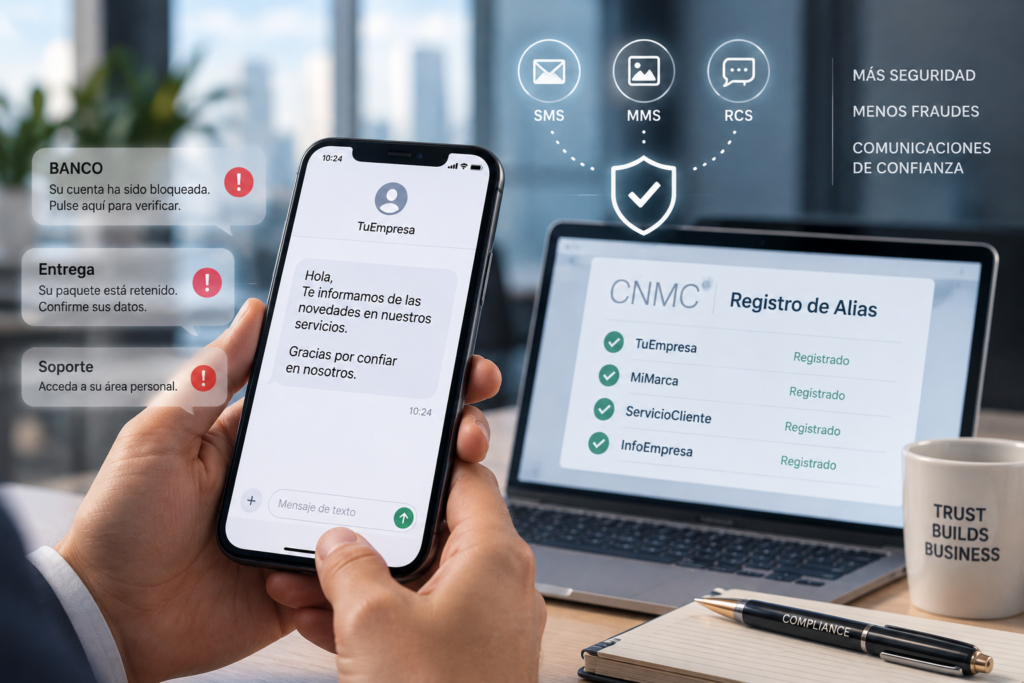
SMS messages continue to be one of the communication channels commonly used by companies to communicate with their customers.
In many of these communications, recipients do not see a telephone number as the sender, but rather the company name, a brand name or a specific trade name. This alphanumeric identifier is what the regulations refer to as an “Alias”.
Until the creation of the new Alias Register, there was no general register in Spain, managed by the Spanish National Commission on Markets and Competition (CNMC), allowing aliases used as senders in SMS, MMS and RCS messages to be linked to their legitimate owners and service providers.
The absence of a general verification system had made it easier for third parties to use well-known names or brands to make certain messages appear to come from legitimate entities, a practice particularly common in identity impersonation and spoofing fraud.
In order to strengthen the security of these communications, Order TDF/149/2025 of 12 February introduced new measures aimed at combating identity impersonation scams and established the creation of a specific register for identifiers used in SMS, MMS and RCS messages.
Subsequently, CNMC Circular 1/2026 of 18 March further developed the operation of the new Alias Register, regulating, among other matters, who may apply for registration, the requirements identifiers must meet and the obligations of service providers involved in the transmission of messages.
Since 15 September 2026, the new system has been fully applicable, and service providers are required to implement the control and blocking mechanisms established under the regulations.
There is, however, an important transitional exception. Circular 3/2026 of 8 September established the temporary pre-registration of aliases for which an application had been submitted before 3:00 p.m. on 14 September 2026, provided that certain basic formatting requirements had been met and the corresponding declarations of compliance had been submitted. These aliases may continue to be used while the CNMC completes the final registration process.
Consequently, in order to continue sending messages using a name, brand or other Alias as the sender identifier, the Alias must be duly registered in the Register and the messages must be transmitted through registered service providers authorised to use it.
Which companies are affected?
In general terms, any company that uses a name, brand, trade name or other identifier as the sender of SMS, MMS or RCS messages should pay particular attention to these new regulations.
The obligation is especially relevant for companies that regularly use these types of messages to communicate with customers, users, employees or suppliers, whether directly or through external technology platforms.
The registration application may be submitted by the Alias owner itself, but it may also be processed through the messaging service provider acting on its behalf or by a duly authorised third party.
The obligation also applies to foreign companies
One particularly relevant aspect for international groups is that the obligation is not limited to companies established in Spain.
Foreign companies wishing to send SMS, MMS or RCS messages using an Alias to recipients with Spanish telephone numbers must also ensure that the identifier is registered in the Alias Register and that the messages are transmitted in accordance with the new requirements.
This may be particularly important for multinational groups that use a single commercial brand in different countries or centralise the sending of communications through technology providers located outside Spain. In such cases, it will be necessary to determine which company owns the Alias, which entity holds the rights to the brand or name being used, and which providers are actually involved in transmitting the messages.
What happens if the Alias is not registered?
Since 15 September 2026, service providers involved in the transmission of messages have been required to implement control and blocking mechanisms.
As a result, certain messages may be blocked if the Alias used is not registered, if the provider is not registered, or if the originating provider is not duly authorised to use that specific identifier.
The Alias must therefore be duly registered, and there must be a clear correspondence between its owner, the authorised providers and the structure used to transmit the messages.
What requirements must the Alias meet?
In order to obtain registration, there must be a legitimate link between the requested Alias and its owner.
This link may be demonstrated, among other means, through:
- a trademark registered with the Spanish Patent and Trademark Office (OEPM) or the European Union Intellectual Property Office (EUIPO);
- a registered trade name;
- the company’s registered corporate name;
- an Internet domain name; or
- certain names or designations registered with other national or international public registers.
The regulations also provide for cases in which the owner does not hold any of these registered rights. In such situations, it may be demonstrated, by means of a declaration of compliance, that the Alias is legitimately and regularly used in the course of the company’s professional or commercial activities.
For SMS and MMS messages, the Alias must also meet certain technical requirements. As a general rule, it must contain between 3 and 11 characters. Letters, numbers, spaces and certain symbols are permitted.
What should companies review now?
Organisations using SMS, MMS or RCS should, at a minimum, carry out the following checks:
- Identify all Aliases currently in use, including any variations of the same brand or name.
- Determine the legitimate owner of each identifier and identify the right, trademark, name or other element supporting its legitimate use.
- Identify potential conflicts with third parties, particularly where the identifier used is identical or may be confused with other trademarks or names.
- Verify that the Alias is duly registered in the CNMC Register.
- Review the technology providers used to send messages, ensuring that they are registered and duly authorised for each Alias.
- For corporate groups, determine which company should be registered as the owner and how authorisations between the different entities should be structured.
- For international companies, also review messages sent from abroad to Spanish telephone numbers.
- Integrate Alias management into any future rebranding process, change of corporate name, acquisition or transfer of trademarks, or change of messaging service provider.
At Feliu N&I, we can assist companies in analysing the Aliases they use, reviewing their connection with trademark rights and other existing distinctive signs, identifying potential conflicts, and defining the strategy required to adapt their communications to the new regulatory requirements.